If you’ve ever picked up two bags of hazelnut flour at the same price point and noticed one smells faintly nutty while the other hits you with a wave of warm, toasted richness — you’ve already encountered the raw-versus-roasted divide. Hazelnut flour is simply ground hazelnuts: the whole nut (or a partially defatted version of it) milled into a fine powder used in place of, or alongside, wheat flour in baking. The roast level of those hazelnuts before grinding turns out to matter enormously — not just for aroma, but for fat behavior, moisture absorption, binding, and how your finished crumb or crust actually tastes. This article breaks down exactly what changes at each roast stage, maps those changes to real baking outcomes, and ends with a clear decision framework so you can stop guessing which bag to reach for.
What Roasting Actually Does to a Hazelnut (Before It Becomes Flour)
To make a smart purchasing call, it helps to understand what’s happening inside the nut during roasting — because the flour inherits all of it.
The Maillard Reaction and Volatile Flavor Compounds
Roasting drives the Maillard reaction (the same browning process that gives bread its crust), which creates hundreds of volatile aromatic compounds. In hazelnuts specifically, the dominant flavor molecules produced are pyrazines — the compounds responsible for that deep, almost chocolatey, roasted-nut note. As documented in America’s Test Kitchen’s coverage of nut chemistry and flavor development, pyrazine concentration increases significantly at roast temperatures above 275°F (135°C), with the steepest development occurring between 300–340°F (149–171°C). Raw hazelnut flour contains almost none of these compounds; lightly roasted flour has moderate levels; dark-roasted flour is saturated with them.
This is not a subtle sensory difference. Side-by-side in a financier or a dacquoise (a French meringue-based nut cake layer), the flavor gap between raw and dark-roasted hazelnut flour can read as two entirely different ingredients.
Fat Migration and Surface Oil
Roasting also mobilizes the fat within the nut. Hazelnuts are high-fat nuts — according to Healthline’s article “Hazelnut Nutrition Facts and Health Benefits,” whole hazelnut fat content runs roughly 60–63% by weight, with the majority being oleic acid, a monounsaturated fat. When heat is applied, cell walls break down and fat migrates toward the surface. Once the nuts are ground into flour, that surface fat is immediately available rather than locked inside cell structures.
The practical consequence: roasted hazelnut flour behaves like a slightly fattier ingredient at the moment of mixing, even if the absolute fat percentage between a raw-ground and roasted-ground flour from the same batch of nuts is technically similar. Fat that is surface-accessible emulsifies faster, coats gluten proteins (or in gluten-free baking, starches and egg proteins) more readily, and can accelerate rancidity during storage.
Serious Eats’ examination of nut flour science — published under their baking science coverage — confirms this distinction: mobile surface fats in roasted nut flours integrate differently into batters compared to the more “inert” fat profile of raw-ground versions.
Moisture Loss and Particle Behavior
Roasting drives off moisture. Depending on roast depth, hazelnuts can lose 3–8% of their water weight. That drier starting material grinds differently: it produces a slightly coarser, more free-flowing flour in most commercial mill contexts, and it absorbs liquid in a batter more aggressively than raw flour does.
Raw hazelnut flour, milled from nuts at ambient moisture levels, tends to be a bit more cohesive right out of the bag and absorbs liquid slightly more slowly. This distinction is small but consequential in applications like macarons or tarts where hydration ratios are precision-driven.
How Roast Level Maps to Baking Performance: The Key Tradeoffs
Here’s where practitioner-level decision-making lives. The flavor upside of roasted flour is obvious — but the structural and chemical tradeoffs are less discussed.
Comparison by Roast Level
| Property | Raw Hazelnut Flour | Light Roast Flour | Dark Roast Flour |
|---|---|---|---|
| Flavor intensity | Mild, grassy, faint nuttiness | Moderate nuttiness, clean | Deep, pyrazine-forward, almost chocolate-adjacent |
| Surface fat availability | Low | Moderate | High |
| Liquid absorption rate | Moderate/slow | Moderate | Fast |
| Rancidity risk (post-opening) | Moderate | Moderate-high | High |
| Shelf stability (sealed) | Better | Moderate | Shortest |
Structure and Binding
In recipes where hazelnut flour is doing structural work — a nut-based tart shell (pâte sucrée aux noisettes), a layer cake crumb, or a gluten-free cookie — roast level affects how the fat interacts with your binding agents (eggs, honey, butter).
Per King Arthur Baking’s guidance on nut flour ratios and substitution, highly defatted or heavily processed nut flours behave closer to conventional flour in terms of liquid need, but most home-accessible hazelnut flours retain substantial fat. The high surface-fat availability in dark-roasted flour means it can compete with butter or oil in emulsion, which in practice translates to: roasted hazelnut flour recipes may feel greasier or shorter (more crumbly) if you use the same fat ratio you’d use with raw flour. You may need to dial fat additions back by 5–10% or compensate with an extra egg yolk for binding.
For raw flour, the opposite risk appears: the more neutral fat profile and slower absorption can leave batters feeling slightly underbaked or dense if liquid isn’t adjusted upward.
Flavor Pairing Compatibility
Food52’s deep dive on hazelnut flour baking makes an important point about pairing logic: raw hazelnut flour is a chameleon. Its mild flavor doesn’t compete with delicate additions — bergamot, rose, white chocolate, citrus zest — making it the right call for applications where you want the hazelnut to be a quiet backdrop rather than a lead flavor.
Roasted hazelnut flour, by contrast, is a dominant note. It pairs naturally with dark chocolate, espresso alternatives like carob, caramel, brown butter, and warming spices (cinnamon, cardamom, clove). Trying to use dark-roasted hazelnut flour in a white chocolate financier or a lemon tart is fighting the ingredient — the pyrazine compounds will push through.
Sourcing Realities: Three Tiers and What You’re Actually Getting
Most buyers encounter hazelnut flour across three distinct sourcing tiers. Roast level, grind quality, and cultivar origin all vary meaningfully across them — and each tier suits a different baker and use case.
Budget Tier: Commodity Raw and Lightly Processed Flours
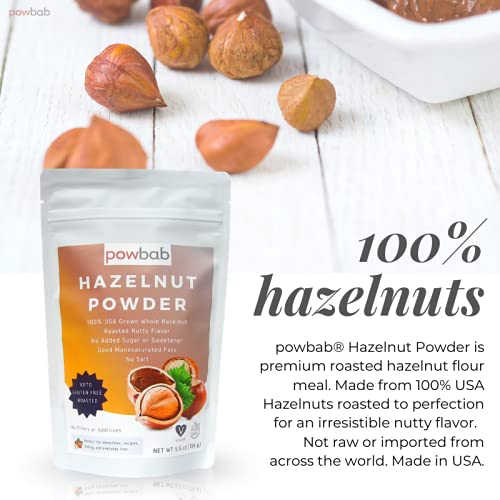
Most commodity hazelnut flours sold at the accessible tier — products from brands like Anthony’s Goods and Bob’s Red Mill — are made from raw or very lightly dried hazelnuts, with minimal roasting. This isn’t a flaw; it’s a deliberate choice for versatility and shelf stability in a mass-market context. The flavor is mild, the grind is relatively coarse, and the fat is well-integrated. These are reliable pantry flours for everyday baking where hazelnut is background texture rather than the star flavor.
For entry-level buyers, the best upgrade path isn’t necessarily seeking a darker roast — it’s seeking a finer grind. A raw-ground, finely milled flour will unlock better macaron shells and cleaner tart doughs before you need to solve for roast level at all.
powbab
$12.99
In stock on Amazon
Check price on AmazonMid-Tier: Blanched, Fine-Ground Domestic Options
Mid-tier options — such as the fine-ground hazelnut flour available from Nuts.com — occupy an interesting middle position. Based on published product descriptions and aggregated buyer feedback, Nuts.com’s version is made from blanched (skin-removed), lightly processed hazelnuts ground to a notably finer consistency than most domestic competitors. Reviewers consistently note a cleaner, more neutral flavor characteristic of raw-adjacent processing, with a fine, almost almond-flour-like texture that performs well in macarons and tart doughs.
Oregon-grown flour (often sourced from Barcelona or Ennis cultivar hazelnuts) used by several domestic mid-tier millers tends toward a milder flavor base than Piedmont imports, even at similar roast levels — a cultivar difference worth factoring in if you’re precision-matching flavor to a specific recipe.
Yupik
$22.88
In stock on Amazon
Check price on AmazonPremium Tier: Piedmont-Origin Roasted Flour
At the premium import level, specialty importers such as Gustiamo — whose sourcing documentation describes their products in detail — typically source Tonda Gentile delle Langhe hazelnuts, the specific cultivar prized for its balanced fat content and complex aroma. According to Gustiamo’s product sourcing documentation, these flours are often roasted to a controlled medium-light level before milling, which means they carry meaningful flavor development without pushing into dark-roast territory. The fat content in Tonda Gentile flour runs on the higher end of the spectrum — some batches reported at 65%+ fat by dry weight — which intensifies both the flavor payoff and the rancidity management requirement.
This tier is the right choice when hazelnut is the entire point of the recipe: a Piedmont-style nut torte, a classic gianduja layer, or a praline cream where the cultivar’s distinctive flavor complexity is worth the premium and the shorter shelf window.
Presto
$26.99
In stock on Amazon
Check price on AmazonStorage: Roast Level Changes Your Rancidity Timeline
This is the operational detail most buyers underestimate. As Healthline’s nutritional coverage of hazelnut fat content notes, the high oleic acid profile of hazelnuts gives them better oxidative stability than nuts with higher polyunsaturated fat content, such as walnuts. But “better stability” is relative — hazelnut flour is still a high-fat, finely ground product with enormous surface area exposed to oxygen.
Roasting accelerates the clock. The mobilized surface fat in roasted hazelnut flour oxidizes faster than the more protected fat in raw flour. In practical terms:
- Raw hazelnut flour (sealed, refrigerated): 4–6 months with reliable quality
- Light-roast flour (sealed, refrigerated): 3–4 months
- Dark-roast flour (sealed, refrigerated): 6–10 weeks before flavor degradation becomes detectable
The tell is always smell: fresh hazelnut flour smells nutty and clean; rancid flour carries a crayon-like, slightly metallic or sour-fat odor. If you’re buying in multi-pound quantities for commercial or semi-commercial use, roasted flour demands faster turnover or freezer storage (sealed airtight — moisture contamination on thaw is the main risk with freezer cycling).
America’s Test Kitchen’s coverage of nut storage practices recommends treating opened nut flour bags like dairy: refrigerate immediately, press out air before resealing, and note the opening date on the bag itself.
The Decision Framework: If X, Then Y
You’ve read the tradeoffs. Here’s how to translate them into a purchase call.
If your recipe features hazelnut as the primary flavor (nut torte, dacquoise, praline anything, chocolate-hazelnut tart) — buy roasted, and buy medium-roast if you can specify. Full pyrazine development is the point. Budget an extra egg or reduce added fat by 5–8%.
If your recipe uses hazelnut flour as a structural or gluten-free base where other flavors lead (fruit tart, lemon cake, delicate macaron shell) — buy raw or light-roast. The neutral backdrop lets your fillings and aromatics read clearly without fighting a dominant nut note.
If you’re buying at volume for commercial or semi-commercial use — factor roast level into your inventory rotation timeline, not just your recipe specs. Dark-roast flour at scale means a committed 6–8 week turnover or dedicated freezer capacity. Raw flour buys you more time.
If you’re in the entry-level segment and working with a standard grocery-tier bag — you’re almost certainly using raw or lightly processed flour already. The best upgrade path isn’t necessarily a darker roast; it’s a finer grind. A raw-ground, finely milled flour will unlock better macaron shells and cleaner tart doughs before roast level even becomes the limiting variable.
If your priority is shelf stability over flavor intensity — raw flour is always the more forgiving buy. The flavor is quieter, but it gives you room to work.
The roast level question isn’t about which is better. It’s about which is better for the specific bake in front of you — and now you have the variables to answer that for yourself.