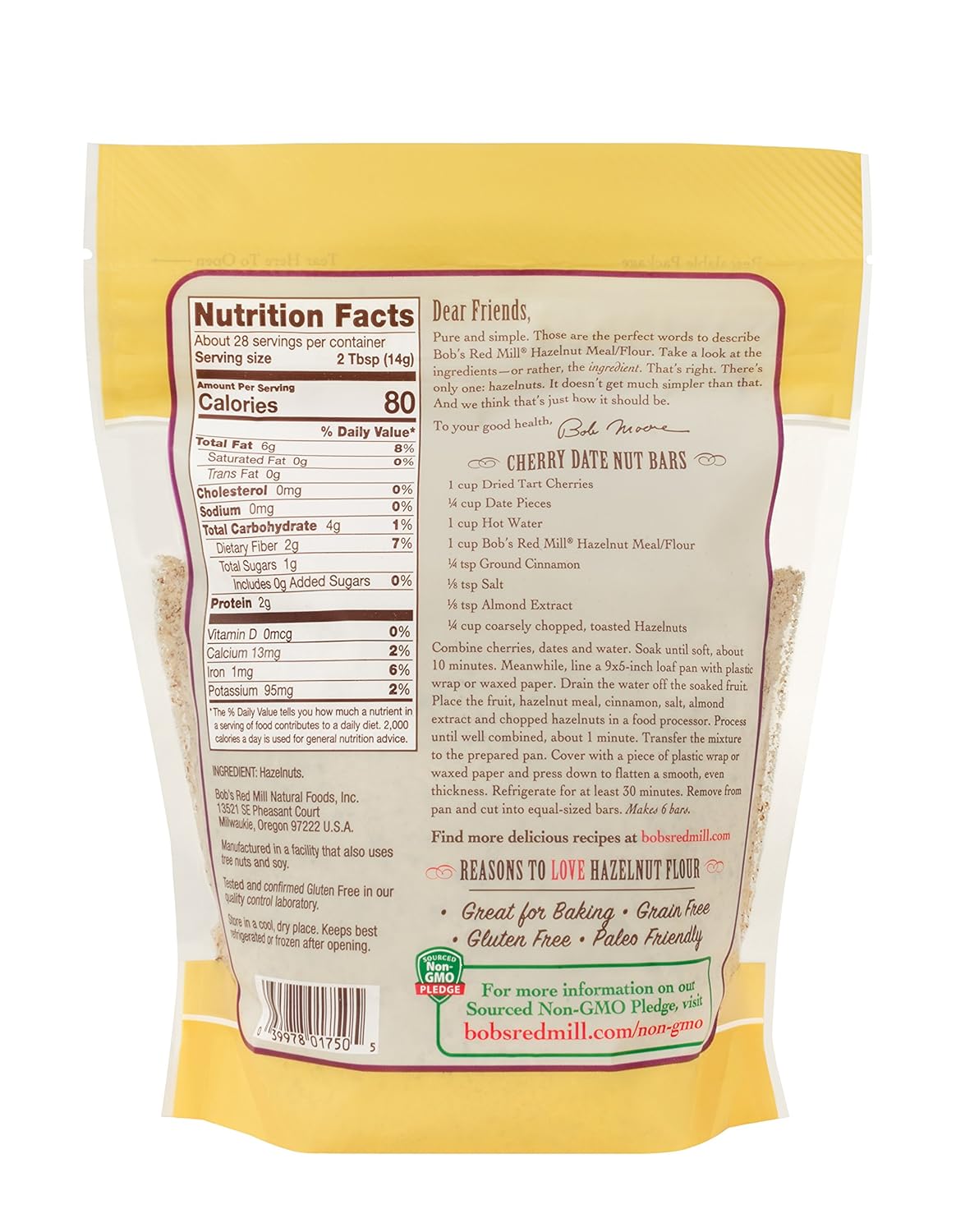
If you’ve ever stood in a specialty grocery aisle holding a small bag of hazelnut flour — ground, roasted hazelnuts with most or all of the skin removed, used in place of wheat flour in cakes, tarts, and pastries — and thought “this feels expensive,” you’re not wrong. But “expensive per bag” and “expensive per recipe” are two very different numbers. Hazelnut flour is used in small quantities: most dacquoise meringue recipes call for 100–150 grams, a Linzer torte might use 200 grams, and a single tart shell can require as little as 80 grams. Once you divide the bag price by how many times you’ll actually reach into it, the $14 option and the $55-per-pound import often end up closer together than their sticker prices suggest — and sometimes the math flips entirely. This article runs those numbers across five real-market price points so you can make the call that fits your bake and your budget.
How the Math Works: Weight, Yield, and the Per-Gram Rate
Before comparing products, you need one consistent unit: cost per gram. Everything else — per-recipe cost, bags-per-year, bulk break-even — derives from that single number.
Here’s the baseline formula:
Cost per gram = bag price ÷ net weight in grams
Then for any recipe:
Recipe cost = grams required × cost per gram
The complication is that hazelnut flour bags are sold in ounces (oz) in the U.S., so you’ll often need a quick conversion: 1 oz = 28.35 grams. A 16 oz bag is 453 grams. A 3 lb bag is 1,361 grams.
One more variable to keep in mind: grind fineness affects volume but not weight. A fine-ground Piedmont-origin flour and a coarser domestic grind might both weigh 100 grams but behave differently in a recipe — the finer flour produces a smoother, more cohesive crumb, which is why serious pastry cooks treat fineness as a quality marker, not just a texture preference. When scaling a recipe for a coarser flour, some bakers add 5–10% more by weight to compensate for lower starch integration. That adjustment changes your per-recipe cost, so it’s noted in the table below.
The Five Price Points: Side-by-Side
Here’s the current May 2026 market picture across the realistic purchase spectrum. Prices reflect standard retail or published bulk rates; actual shelf prices vary by retailer and region.
| Product / Source | Package Size | Price (approx.) | Cost per Gram | Cost: 150g Recipe | Cost: 250g Recipe |
|---|---|---|---|---|---|
| Bob’s Red Mill Hazelnut Flour | 14 oz (397g) | ~$14 | $0.035 | $5.25 | $8.75 |
| Anthony’s Goods Fine Ground | 1 lb (453g) | ~$17 | $0.038 | $5.70 | $9.50 |
| Nuts.com Fine-Ground Hazelnut | 1 lb (453g) | ~$24 | $0.053 | $7.95 | $13.25 |
| Gustiamo / Piedmont Import | ~1 lb (450g) | ~$48–55 | $0.107–0.122 | $16.05–$18.30 | $26.75–$30.50 |
| Oregon Bulk (small-batch mill, 5 lb) | 5 lb (2,268g) | ~$95–119 | $0.042–0.052 | $6.30–$7.80 | $10.50–$13.00 |
By the numbers:
- A 150g dacquoise layer costs $5.25 in Bob’s Red Mill flour — or $18.30 at Gustiamo Piedmont pricing. That’s a $13 difference on a single component.
- The Oregon 5 lb bulk order ($119) drops to roughly $0.052/g — nearly identical to Nuts.com by the gram, but you’re committing to 2,268g at once.
- The break-even point for the Oregon bulk order vs. buying four single-pound bags at Anthony’s Goods pricing: approximately 11 recipes of 250g each. If you bake hazelnut-forward pastries weekly, that’s less than three months of baking.
The Rancidity Variable: Why Storage Changes the Real Cost
There’s a number missing from most per-recipe cost discussions: spoilage loss. Hazelnut flour is high in unsaturated fat — roughly 60–65% fat by weight in most commercial grinds, per published specifications from both Bob’s Red Mill and Anthony’s Goods. Those fats oxidize and go rancid, especially once a bag is opened and exposed to air and light. An opened bag stored at room temperature in a warm kitchen can go off in as little as 3–4 weeks. A sealed bag in a freezer will hold 6–12 months.
This matters because the 5 lb bulk order that looks economical at $0.052/g becomes significantly more expensive if you discard a pound due to rancidity. King Arthur Baking’s nut flour storage guide recommends airtight containers in the freezer as the default for any nut flour opened more than two weeks prior — not a suggestion, a baseline.
Practical decision rule for bulk buyers: Before committing to a 5 lb order, calculate your realistic monthly usage. If a typical month covers two to three 250g recipes plus incidental use in cookies or muffins, you’re using 600–900g per month — meaning a 5 lb purchase is consumed in two to three months, well within safe frozen storage range. If you bake hazelnut recipes only occasionally, the 1 lb Anthony’s Goods or Bob’s Red Mill bag is cheaper in practice even if it’s higher per gram on paper, because you’re not paying for flour you’ll eventually throw away.
Serious Eats’ overview of nut flour behavior in baking notes that rancidity in hazelnut flour manifests first as a bitter finish in baked goods — easy to miss in a spiced cookie, harder to ignore in a delicate financier where the nut flavor is front and center. If you’re sourcing premium Piedmont flour at $0.11/g, that’s an especially expensive mistake.
When the Premium Import Is Actually Worth It
Here’s where the analysis gets more nuanced. The Gustiamo Piedmont pricing — $48–55 for approximately one pound — represents roughly a 3x premium over Bob’s Red Mill by the gram. That’s real money. But the cost argument for premium import flour isn’t just about prestige; it’s about cultivar flavor concentration and grind fineness.
Piedmont hazelnuts (specifically the Tonda Gentile delle Langhe variety, the dominant cultivar in the Langhe region of northern Italy) are documented to carry a higher concentration of aromatic volatile compounds than most Oregon-grown Willamette Valley cultivars. Gustiamo’s sourcing notes, published on their site, describe relationships with specific growers in Piedmont and emphasize traceability to individual harvests. For a Nutella-adjacent chocolate-hazelnut torte where hazelnut is the primary flavor, that aromatic intensity is detectable in the finished bake — and reviewers across Food52’s community notes on hazelnut flour consistently describe Piedmont-origin flours as producing a noticeably more complex, roasted-nut flavor profile compared to commodity domestic ground.
The grind fineness question is separate. Piedmont imports are typically milled to a finer particle size than most domestic commodity grinds, which affects moisture absorption and the finished texture of meringue-based applications like dacquoise. If you’re building a layered entremet where every component needs to behave predictably, the finer grind isn’t a luxury — it’s quality control.
The honest tradeoff: At $16–18 per recipe for a 150g dacquoise, you’re paying approximately $10–13 more than you would with Bob’s Red Mill. For a home baker making that torte for a dinner party once a month, that’s a $120–156 annual premium for meaningfully better flavor. That’s defensible. For a patisserie baking dacquoise four days a week, the math reverses: even a modest flavor upgrade doesn’t justify $10+ more per batch when multiplied across hundreds of bakes annually. That’s when Oregon bulk at $0.042–0.052/g becomes the serious choice.
The Entry-Level Case: Bob’s Red Mill and Anthony’s Goods
For bakers newer to hazelnut flour or those building intuition for how it behaves before spending more, Bob’s Red Mill and Anthony’s Goods are the right starting point — and not just for budget reasons.
Bob’s Red Mill’s hazelnut flour (listed at approximately $14 for 14 oz as of May 2026) is consistently available at natural grocery chains and ships reliably. The grind is described on the package as “finely ground,” though experienced bakers report it is slightly coarser than specialty imports. For cookies, quick breads, and recipes where hazelnut is a supporting flavor rather than the star, this performance gap is largely irrelevant.
Anthony’s Goods positions itself a step up — their fine-ground hazelnut flour is processed to a finer consistency than Bob’s by most user accounts, and at approximately $17/lb it sits in a rational middle tier. Food52’s community discussions on hazelnut flour substitutions frequently cite Anthony’s Goods as the value benchmark for bakers who want reliable grind consistency without importing.
For anyone deciding between the two: if your recipe is a Linzer torte, a hazelnut shortbread, or a banana-hazelnut loaf, the $3 difference per pound is not the deciding factor. Grind consistency and freshness of the batch you’re buying matter more — and Anthony’s Goods has slightly stronger reviews on batch consistency in aggregated community feedback.
The Decision Framework
Here’s the “if X, then Y” view:
If you bake hazelnut-forward recipes weekly (dacquoise, tortes, hazelnut-centric financiers) and can commit to proper freezer storage: the Oregon 5 lb bulk order at $95–119 is your most economical serious option, landing at roughly the same per-gram cost as Nuts.com single-pound bags but with better unit economics at volume. Run the math on your monthly usage before ordering.
If you want the best possible flavor for a high-stakes bake (a dessert course for a dinner party, a patisserie special, a competition entry): Gustiamo Piedmont is the defensible choice. The per-recipe premium is real but bounded — $10–13 more per component, not per finished dessert.
If you’re building your hazelnut flour intuition or need a reliable everyday bake supply without bulk commitment: Anthony’s Goods at $17/lb or Bob’s Red Mill at $14/14 oz both work. Start here, track your usage for two months, then revisit the bulk math.
If you’re purchasing for semi-commercial volume (a boutique patisserie or serious home baker running multiple hazelnut components per week): the per-gram rate on Oregon bulk makes domestic 5 lb orders the rational anchor, with occasional Piedmont imports reserved for applications where the flavor justification is clear and passed on in the finished product’s price point.
The bag on the shelf looks expensive. The recipe in your notebook tells the real story.