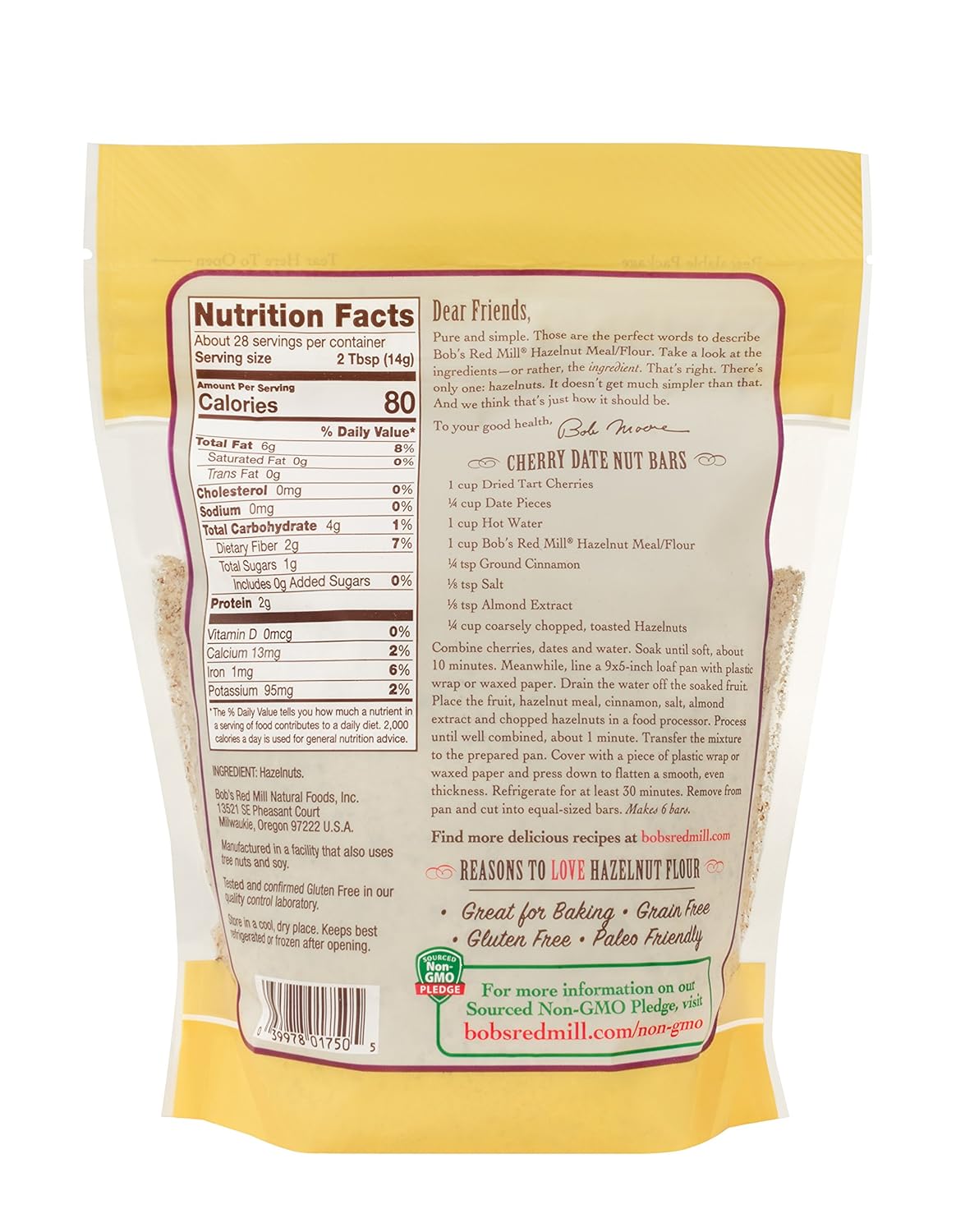
If you’ve ever cracked open a bag of hazelnut flour and wondered why one brand bakes into a silky macaron shell while another turns your financiers grainy and dense, you’re not imagining things. Hazelnut flour — raw hazelnuts that have been ground into a fine, dry powder — varies significantly from brand to brand in two properties that matter enormously in the pastry kitchen: grind fineness (how finely the nuts were milled, which determines texture) and fat content (how much of the nut’s natural oil remains in the flour after processing, which affects both moisture absorption and flavor). These aren’t marketing details. They’re the variables that determine whether your dacquoise (a French meringue-and-nut-flour layer cake component, pronounced “dah-KWAHZ”) shatters cleanly or turns chewy, and whether your macarons (the French sandwich cookies built on a meringue-and-nut-flour batter) develop smooth, even feet or crack across the top. This guide breaks down what those two variables mean in practice — and builds a decision framework so you can match the right flour to each specific bake.
| EDITOR'S PICK[Oh! Nuts Flour | Fresh Flour in…](https://www.amazon.com/dp/B00XIFKGZ8?tag=greenflower20-20) | Mid-tierOh! Nuts Flour | Fresh Flour in… | Budget pick[Amoretti - Natural Hazelnut Flo…](https://www.amazon.com/dp/B01GLP12E0?tag=greenflower20-20) | |
|---|---|---|---|
| Package size | — | — | 1 lb |
| Certified Kosher | ✓ | ✓ | — |
| Dairy & Egg Free | ✓ | ✓ | — |
| Resealable bag | ✓ | ✓ | — |
| Price | $35.00 | $31.00 | $19.01 |
| See on Amazon → | See on Amazon → | See on Amazon → |
Why Grind Fineness Is the Variable You Probably Underestimate
Grind fineness is measured informally in the specialty baking world by how a flour feels between your fingers and how it behaves when sifted. Practically speaking, most hazelnut flours on the market fall into three rough categories:
- Coarse-ground / meal: visible nut particulate, gritty texture, often labeled “hazelnut meal.” Typical of Bob’s Red Mill and similar accessible brands.
- Standard fine-ground: smooth but not silky, passes through a medium sieve with some residue. Most mid-range domestic products, including Anthony’s Goods and Nuts.com fine-ground.
- Extra-fine / stone-milled: near-powdery, passes cleanly through a fine sieve, minimal residue. Characteristic of Piedmont-origin stone-milled imports and some domestic small-batch mills.
The difference isn’t just cosmetic. In a French macaron, the meringue-based batter (called tant pour tant — “so much for so much,” meaning equal weights of nut flour and powdered sugar) depends on a very fine particle structure to fold smoothly into the egg whites without deflating them. Per Serious Eats’ detailed macaron analysis, any coarse particle that interrupts the batter’s surface tension will telegraph directly to the shell — you’ll see pitted, rough tops instead of the glassy dome that tells you the batter was properly macaronaged (the specific folding technique used to knock air out of macaron batter to the right consistency).
In a dacquoise, the stakes shift slightly. Dacquoise layers are piped and baked as nut meringue discs, and they require enough structural integrity to hold their crisp edges after baking. Food52’s coverage of nut flour baking notes that coarser nut flour in dacquoise can actually improve structural bite — too fine a grind, without compensating for fat content, produces a disc that’s more cookie-fragile than crunch-crisp. This is one of the few cases where a standard-grind flour outperforms an ultra-fine one.
Financiers (small, butter-rich almond or hazelnut cakes baked in rectangular molds, with a moist, dense crumb and a characteristic browned-butter flavor) sit in the middle. Financier batter is wet enough that particle size matters less than in macaron work — the brown butter (called beurre noisette, literally “hazelnut butter,” named for its hazelnut-like aroma) does a lot of work to hydrate even coarser particles. America’s Test Kitchen’s gluten-free baking coverage confirms that financier batter is among the most forgiving of nut flour applications, which makes it a good starting point if you’re calibrating a new flour source.
Fat Content: The Variable That Changes Everything Downstream
Here’s where things get counterintuitive. Higher fat content in a hazelnut flour sounds like it should mean more flavor and richness — and it does — but it also means the flour behaves more like a wet ingredient than a dry one. Standard hazelnut flour runs roughly 55–65% fat by weight (hazelnuts are naturally one of the higher-fat tree nuts). Partially defatted hazelnut flour — produced by pressing some of the oil out before milling — drops that to 20–40%, producing a drier, more absorbent powder that behaves closer to wheat flour in liquid ratio and structure.
By the numbers:
| Flour type | Approx. fat content | Liquid absorption | Best application |
|---|---|---|---|
| Full-fat hazelnut flour | 55–65% | Low | Financiers, frangipane, cookies |
| Standard fine-ground | 48–58% | Medium | Macarons, dacquoise, tarts |
| Partially defatted | 20–40% | High | Blended GF flour mixes, keto baking |
King Arthur Baking’s nut flour guide flags fat content as the primary reason nut flour recipes don’t translate 1:1 across brands — a recipe developed on a defatted flour will produce a greasy, flat result if you substitute a full-fat stone-milled import at the same weight. The fix isn’t intuitive: you need to reduce the butter or oil in the recipe, not the nut flour, because the flour itself is already contributing significant fat to the total.
For macaron work specifically, this is critical. Macarons are particularly sensitive because the nut flour’s fat must not contaminate the meringue’s foam structure. Bakers on the practitioner end of the spectrum often dry their nut flour briefly in a low oven (around 200°F / 93°C for 8–10 minutes) before folding it into the batter — not to toast it, but to drive off surface moisture and reduce the risk that residual oil will break the meringue. This step is especially important with full-fat, freshly ground flours. Gustiamo’s sourcing notes on Piedmont hazelnuts point out that freshly processed IGP-certified Tonda Gentile hazelnuts (a specific cultivar grown in the Piedmont region of Italy, holding Protected Geographical Indication status) have measurably higher moisture and fat expression immediately after harvest than older, more shelf-stable commercial stock — flavor is superior, but the baking math shifts.
Matching Flour to Bake: A Decision Framework
This is where grind fineness and fat content intersect in ways that actually change your purchasing decision.
Macarons: Prioritize fineness, control fat
For macarons, the non-negotiable is particle size. You want flour that passes through a fine-mesh sieve (200 microns or finer, if you have a way to test) with less than 10% residue by weight. Standard-grind accessible flours — Bob’s Red Mill, Anthony’s Goods — will almost always require sifting and discarding of coarser particles, which means you’re paying for flour you won’t use. At $12–18 per bag, that’s still economical, but the labor is real. An extra-fine stone-milled flour at $40–55 per pound eliminates that step entirely and delivers a more consistent result across batches.
On fat: for macarons, a flour in the 48–56% fat range is the sweet spot. Full-fat imports at the high end of natural fat content benefit from the low-oven drying step. If you’re running a production volume where consistency is critical, partially defatted flour blended back with full-fat at a 60/40 ratio is a technique some boutique patisseries use to standardize fat input without losing hazelnut intensity.
Financiers: Fat content matters more than fineness
Financiers are butter cakes at heart. The beurre noisette is the star; the nut flour is structural and aromatic support. Standard-grind flours work well here, which makes financiers an ideal application for mid-range flours like Nuts.com fine-ground or Anthony’s Goods — you get the flavor contribution without paying for an extra-fine grind you won’t fully perceive in the finished crumb. If you do use a Piedmont-origin full-fat flour, reduce the butter in your recipe by 10–15% by weight and expect a slightly denser, moister crumb — often a positive trade-off given the flavor payoff.
Dacquoise: The case for standard-grind
Dacquoise is the one application where extra-fine grinding can work against you. The slight textural variation in a standard-grind flour gives dacquoise its characteristic bite — that contrast between the crisp exterior and the slightly chewy interior that holds up when sandwiched with buttercream or mousse. America’s Test Kitchen’s gluten-free baking coverage notes that nut meringue layers made with ultra-fine flour tend to be more delicate and harder to handle when assembling layered cakes. If you’re sourcing specifically for dacquoise production, a standard-grind domestic flour at $18–30 per pound is likely the better call than a premium Piedmont import — you’re not extracting the value that extra-fine grind offers in this application.
Storage, Rancidity, and the Hidden Cost of High-Fat Flour
One practical note that affects the economics of premium hazelnut flour: fat content is directly correlated with rancidity risk. At 55–65% fat, full-fat hazelnut flour has a significantly shorter usable shelf life than lower-fat alternatives. Opened bags stored at room temperature can turn rancid within 4–6 weeks in a warm kitchen. Vacuum-sealed and refrigerated, most producers rate full-fat hazelnut flour at 3–4 months; frozen, up to a year.
This matters for the price-per-recipe math. A $45 bag of Piedmont-origin stone-milled flour that you can only use through in six weeks before quality degrades is effectively more expensive than it looks — especially at low production volumes. If you’re a home baker running one or two macaron batches per month, portioning into smaller vacuum-sealed bags and freezing the remainder is not optional; it’s the only way the economics work. For boutique patisseries sourcing in multi-pound quantities, rotating stock on a 30-day cycle and building flour cost into recipe costing at the full purchase price (not amortized over a theoretical shelf life) is the more accurate accounting approach.
Gustiamo’s sourcing documentation and the general guidance from Food52 on high-fat nut flour storage both emphasize refrigeration as the minimum standard for any flour with more than 45% fat content — room-temperature pantry storage is appropriate only for partially defatted versions.
The Decision Rules, Plainly Stated
If you’re deciding which hazelnut flour to stock right now, here’s the framework:
- If you’re making macarons and want consistent results with minimal sifting labor: source an extra-fine stone-milled flour (Piedmont IGP origin or domestic small-batch stone-milled), budget $40–55/lb, and use the low-oven drying step if the flour is fresh.
- If you’re making financiers and want the best flavor-to-cost ratio: Nuts.com fine-ground or Anthony’s Goods at standard grind gives you 90% of the flavor at 30% of the cost. Full-fat imports are a luxury here, not a necessity.
- If you’re making dacquoise: standard-grind is the correct tool. Don’t over-invest in extra-fine flour for this application.
- If you’re running multi-product production across all three: stock two flours — an extra-fine for macaron work, a standard-grind domestic for financiers and dacquoise — and manage them as separate cost inputs. The blended per-recipe cost across a full pastry program is often lower than sourcing one premium flour for everything.
The grind fineness and fat content aren’t hierarchy markers — the $12 bag isn’t inferior to the $50 import in every context. They’re tools, and like any tool, matching them to the job is the actual skill.