If you’ve ever grabbed a bag of hazelnut flour — ground hazelnuts milled until they’re powdery enough to bake with — and wondered why your financiers came out greasy while a friend’s looked bakery-perfect, the answer is almost certainly grind fineness. Grind fineness refers to how finely the hazelnuts have been milled: a coarser grind leaves larger particles that release fat unevenly during baking, while a finer grind behaves more like conventional flour, distributing fat and moisture more predictably throughout the batter. It sounds like a small technical detail, but it’s the single variable that most directly controls whether a nut-flour bake is tender and cohesive or crumbly and slick. This article compares three brands that home bakers and pastry professionals are actively buying in 2026 — Bob’s Red Mill, Yupik, and Presto Oregon — across the metrics that matter most: particle size, fat content, real-world baking behavior, and cost per recipe.
Why Grind Fineness Is the Metric That Matters Most
Before getting into brand specifics, it’s worth understanding what grind is actually doing to your bake — because this is where most intermediate bakers are still building intuition.
Hazelnut flour is high-fat by nature, typically running between 55% and 62% fat by dry weight depending on the cultivar and roast level. That fat is mechanically locked inside cell walls during milling, and how thoroughly those walls are broken determines how the fat behaves in the oven. With a coarse grind, fat cells remain partially intact and rupture unevenly under heat, creating pockets of grease and inconsistent crumb structure. With a fine grind, fat is more evenly distributed throughout the flour matrix before baking even begins, which translates to more consistent spread, lift, and moisture retention.
Serious Eats, in their guide to baking with nut flours, notes that particle size is a more reliable predictor of bake outcome than brand reputation alone. America’s Test Kitchen, in their research document on high-fat flours in gluten-free baking, echoes this finding — identifying grind inconsistency, not fat content by itself, as the primary driver of greasy or dense results in nut-flour cakes and tarts.
The practical implication: two bags of “hazelnut flour” at similar price points can behave like entirely different ingredients. The brand comparison below is, at its core, a comparison of how each manufacturer has solved — or not solved — the grind consistency problem.
Brand-by-Brand Breakdown
Bob’s Red Mill Hazelnut Flour (~$12–16 / 14 oz bag)
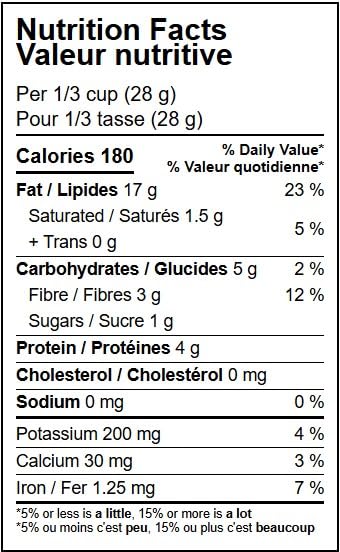
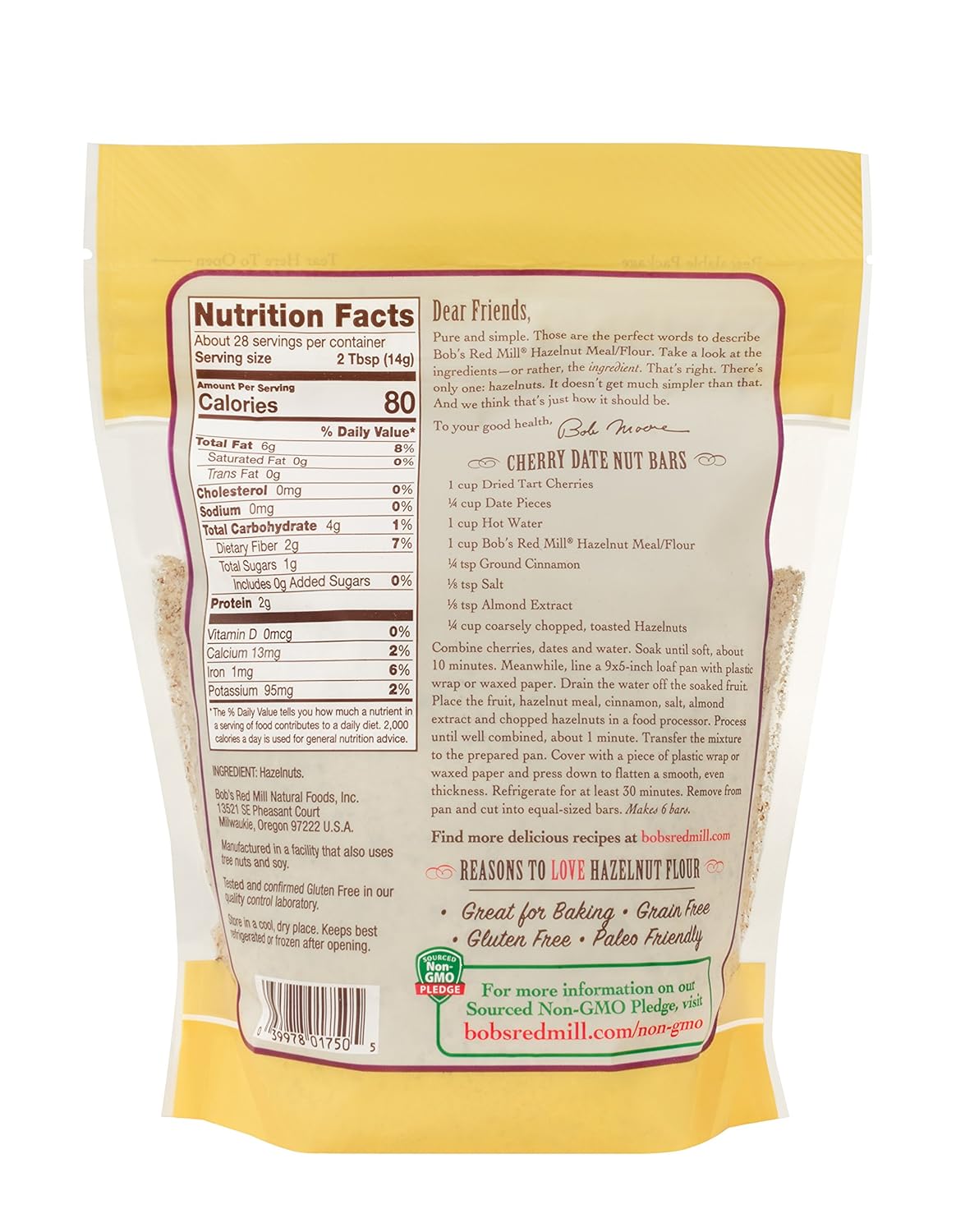
Bob’s Red Mill is the most widely available hazelnut flour in U.S. grocery channels, and for many bakers it serves as the entry point to the category. The product specification sheet published by Bob’s Red Mill describes the flour as “finely ground,” and the published nutritional panel shows approximately 17g fat per 28g serving — a fat percentage of roughly 60%, which is on the higher end for a non-defatted flour.
In practice, baking communities and recipe developers — including discussions hosted through King Arthur Baking’s community resources and Food52’s recipe developer forums — consistently describe this flour as medium-fine rather than truly fine. The grind is adequate for cookies, energy balls, and rustic tart crusts where some textural variance is acceptable. Where it underperforms is in applications requiring a clean, even crumb: financiers, dacquoise, or fine-ground tart shells where particle uniformity is non-negotiable. Practitioners working with this flour regularly note that sifting through a fine-mesh sieve before use removes a meaningful volume of coarser particles before they consider the flour ready for precision work.
King Arthur Baking’s nut flour guide recommends sifting all nut flours before use in any recipe where they substitute for almond flour — a step that is effectively mandatory with Bob’s Red Mill in precision pastry contexts.
Yupik
$22.88
In stock on Amazon
Check price on AmazonYupik Hazelnut Flour (~$14–18 / 1 kg bag)
Yupik is a Canadian specialty food brand with strong distribution across the U.S. Northeast and significant presence in online retail, where it is frequently purchased by keto and paleo recipe developers buying in bulk. The 1 kg format makes the per-gram cost competitive — roughly $0.014–0.018 per gram — which undercuts Bob’s Red Mill on a cost-per-recipe basis for high-volume users.
Yupik’s published nutritional panel shows a fat content closely aligned with Bob’s Red Mill at approximately 60% by weight. However, recipe developers and food writers who have worked with this product — including contributors to Food52 — consistently describe the texture as coarser than Bob’s Red Mill, closer to a hazelnut meal (a term used for a grind that retains significant particle size and texture) than a true flour. This makes Yupik well-suited for applications where texture is an asset: nut-crusted proteins, crumble toppings, energy bars, granola clusters.
Food52, in their troubleshooting guide on greasy nut-flour bakes, specifically identifies coarse-ground hazelnut meals as a common culprit in financier failures — a failure mode that maps directly to what Yupik’s grind profile produces at oven temperature.
Bob's
$16.83
In stock on Amazon
Check price on AmazonPresto Oregon Hazelnut Flour (~$28–38 / 1 lb bag)
Presto Oregon occupies a different tier entirely. Sourced from Oregon-grown hazelnuts — the Willamette Valley accounts for the substantial majority of U.S. hazelnut production — Presto mills to a finer specification than either of the above brands. The company markets to professional pastry kitchens and specialty bakers, and its product documentation emphasizes grind consistency as a primary quality marker, the kind of language that signals a manufacturer calibrating to a professional buyer rather than a retail grocery shelf.
The fat content on Presto’s published specification runs slightly lower than Bob’s Red Mill or Yupik — approximately 56–58% — which is consistent with a tighter milling process that may involve partial defatting or a different cultivar baseline. King Arthur Baking’s nut flour guide notes that Oregon-grown hazelnuts tend toward slightly different fat profiles than imported European varieties, with a milder, less assertive roasted flavor that some pastry chefs prefer for delicate applications such as financiers and macarons.
Practitioners working in professional pastry contexts who have used Presto Oregon note that the flour sifts cleanly with minimal waste, produces consistent spread in dacquoise and macarons, and requires no additional processing before use. America’s Test Kitchen’s research on high-fat gluten-free flours is instructive here: when particle size is uniform, fat distributes evenly through the batter during mixing, and the structural results in the oven are predictable in a way that coarser grinds simply cannot replicate.
The tradeoff is price. At $28–38 per pound, the cost-per-recipe math only pencils out when the application justifies it.

Presto
$26.99
In stock on Amazon
Check price on AmazonBy the Numbers
| Brand | Approx. Price | Format | Fat % (approx.) | Grind Classification | Best Application |
|---|---|---|---|---|---|
| Bob’s Red Mill | $12–16 | 14 oz | ~60% | Medium-fine | Cookies, rustic crusts, everyday baking |
| Yupik | $14–18 | 1 kg | ~60% | Coarse / meal | Crumbles, bars, textured crusts |
| Presto Oregon | $28–38 | 1 lb | ~56–58% | Fine / precision | Dacquoise, financiers, fine tart shells |
The Variables Practitioners Get Wrong
Assuming “Hazelnut Flour” Is a Standardized Term
It isn’t. Unlike all-purpose or bread flour, “hazelnut flour” carries no regulatory grind specification in the United States or Canada. The term is applied to everything from a relatively fine ground product to what is functionally hazelnut meal. This means brand selection is a more consequential decision for nut flours than for grain flours — the label tells you almost nothing about particle size. Serious Eats, in their nut flour baking guide, makes this point explicitly, advising readers to treat the label as a starting hypothesis rather than a reliable descriptor of grind quality.
Conflating Fat Content With Grind Quality
A higher fat percentage does not indicate a coarser or finer grind. These are independent variables. A coarse-ground flour can carry the same fat percentage as a fine-ground flour from the same cultivar. The difference is how that fat is distributed in the flour matrix and how it behaves during mixing and baking. America’s Test Kitchen’s research on high-fat gluten-free flours distinguishes these dimensions explicitly: fat content affects flavor richness and moisture retention, while particle size governs texture and structural integrity. Treating them as the same variable is one of the most reliable ways to produce a recipe failure.
Skipping the Sift
This is the most actionable intervention available regardless of which brand you’re using. Running hazelnut flour through a fine-mesh sieve before incorporating it removes coarser particles and breaks apart compacted clumps. For Bob’s Red Mill, sifting is effectively a required step in precision applications. For Presto Oregon, it functions more as a quality-assurance check. King Arthur Baking’s nut flour guide recommends sifting all nut flours before use in recipes that specify almond flour, since the two are frequently substituted and almond flour recipes are typically calibrated for a fine, consistent grind.
Ignoring How Storage Affects Grind Performance
High-fat flours go rancid significantly faster than grain flours because unsaturated fats oxidize at room temperature. Rancid hazelnut flour doesn’t just taste off — it affects bake structure by altering how fat interacts with eggs and sugar during emulsification. Food52’s guidance on nut flour storage recommends refrigerating hazelnut flour after opening and using it within two to three months, or freezing it for up to six months. At Presto Oregon’s price point, this is a financial consideration as much as a quality one: a bag left at room temperature for several months represents a meaningful ingredient cost written off.
The Decision Rule
If your application is precision French pastry — financiers, dacquoise, fine tart shells, macarons — and you need reliable crumb uniformity, Presto Oregon is the only choice in this comparison that performs without workarounds. The price premium is real, but the cost-per-recipe delta is smaller than it looks. A standard batch of twenty-four financiers uses roughly 80–100g of hazelnut flour, putting flour cost at approximately $2.50–4.00 per batch at Presto’s price versus $1.00–1.50 at Bob’s Red Mill. If you’re presenting those financiers professionally or selling them, the margin on improved quality far exceeds the ingredient differential.
If you’re baking for volume — keto bars, granola, crumble-topped cakes, or any application where textural variation is acceptable or welcome — Yupik’s cost structure and bulk format make it the rational choice. The coarser grind is a feature in these contexts, not a liability.
If you’re in the middle — serious about your bakes, building familiarity with hazelnut flour as an ingredient, not yet ready to commit to a premium-tier product — Bob’s Red Mill is the right starting point, with the explicit understanding that sifting is non-negotiable and that some applications will hit a performance ceiling. Use it to develop intuition about how hazelnut flour behaves, then move up the grind quality ladder when the recipe demands it.
The three brands aren’t competing for the same baker. Once you identify which baker you are right now, the choice makes itself.